Friday, 3 May 2013

Fish, by D H Lawrence


Fish, oh Fish,
So little matters!

Whether the waters rise and cover the earth
Or whether the waters wilt in the hollow places,
All one to you.

Aqueous, subaqueous,
Submerged
And wave-thrilled.

As the waters roll
Roll you.
The waters wash,
You wash in oneness
And never emerge.

Never know,
Never grasp.

Your life a sluice of sensation along your sides,
A flush at the flails of your fins, down the whorl of your
    tail.
And water wetly on fire in the grates of your gills;
Fixed water-eyes.

Even snakes lie together.

But oh, fish, that rock in water.
You lie only with the waters;
One touch.

No fingers, no hands and feet, no lips;
No tender muzzles,
No wistful bellies,
No loins of desire,
None.

You and the naked element.
Sway-wave.
Curvetting bits of tin in the evening light.

Who is it ejects his sperm to the naked flood?
In the wave-mother?
Who swims enwombed ?
Who lies with the waters of his silent passion, womb-
    element?
—Fish in the waters under the earth.

What price his bread upon the waters?

Himself all silvery himself
In the element
No more.

Nothing more.

Himself,
And the element.
Food, of course!
Water-eager eyes,
Mouth-gate open
And strong spine urging, driving;
And desirous belly gulping.

Fear also!
He knows fear!
Water-eyes craning,
A rush that almost screams,
Almost fish-voice
As the pike comes…
Then gay fear, that turns the tail sprightly, from a shadow.

Food, and fear, and joie de vivre.
Without love.

The other way about:
Joie de vivre, and fear, and food,
All without love.

Quelle joie de vivre
Dans I’eau!
Slowly to gape through the waters,
Alone with the element;
To sink, and rise, and go to sleep with the waters;
To speak endless inaudible wavelets into the wave;
To breathe from the flood at the gills,
Fish-blood slowly running next to the flood, extracting fish-
    fire;
To have the element under one, like a lover;
And to spring away with a curvetting click in the air,
Provocative.
Dropping back with a slap on the face of the flood.
And merging oneself!

To be a fish !

So utterly without misgiving
To be a fish
In the waters.

Loveless, and so lively!
Born before God was love,
Or life knew loving.
Beautifully beforehand with it all.

Admitted, they swarm in companies,
Fishes.
They drive in shoals.
But soundless, and out of contact.
They exchange no word, no spasm, not even anger.
Not one touch.
Many suspended together, forever apart.
Each one alone with the waters, upon one wave with the rest.

A magnetism in the water between them only.

I saw a water-serpent swim across the Anapo,
And I said to my heart, look, look at him!
With his head up, steering like a bird!
He’s a rare one, but he belongs…


But sitting in a boat on the Zeller lake
And watching the fishes in the breathing waters
Lift and swim and go their way—
I said to my heart, who are these?
And my heart couldn’t own them…
A slim young pike, with smart fins
And grey-striped suit, a young cub of a pike
Slouching along away below, half out of sight,
Like a lout on an obscure pavement…

Aha, there’s somebody in the know!

But watching closer
That motionless deadly motion,
That unnatural barrel body, that long ghoul nose,…
I left off hailing him.

I had made a mistake, I didn’t know him,
This grey, monotonous soul in the water,
This intense individual in shadow,
Fish-alive.

I didn’t know his God,
I didn’t know his God.

Which is perhaps the last admission that life has to wring
    out of us.

I saw, dimly,
Once a big pike rush.
And small fish fly like splinters.
And I said to my heart, there are limits
To you, my heart;
And to the one God.
Fish are beyond me.


Other Gods
Beyond my range… gods beyond my God. .
They are beyond me, are fishes.
I stand at the pale of my being
And look beyond, and see
Fish, in the outerwards,
As one stands on a bank and looks in.
I have waited with a long rod
And suddenly pulled a gold-and-greenish, lucent fish from
    below,
And had him fly like a halo round my head,
Lunging in the air on the line.

Unhooked his gorping, water-horny mouth.
And seen his horror-tilted eye,
His red-gold, water-precious, mirror-flat bright eye;
And felt him beat in my hand, with his mucous, leaping
    life-throb.

And my heart accused itself
Thinking: I am not the measure of creation.
This is beyond me, this fish.
His God stands outside my God.


And the goId-and-green pure lacquer-mucus comes off in my
    hand.
And the red-gold mirror-eye stares and dies,
And the water-suave contour dims.

But not before I have had to know
He was born in front of my sunrise.
Before my day.

He outstarts me.
And I, a many-fingered horror of daylight to him,
Have made him die.

Fishes,
With their gold, red eyes, and green-pure gleam, and
    under-gold.
And their pre-world loneliness,
And more-than-lovelessness.
And white meat;
They move in other circles.

Outsiders.
Water-wayfarers.
Things of one element.
Aqueous,
Each by itself.

Cats, and the Neapolitans,
Sulphur sun-beasts.
Thirst for fish as for more-than-water;
Water-alive
To quench their over-sulphureous lusts.

But I, I only wonder
And don’t know.
I don’t know fishes.

In the beginning
Jesus was called The Fish.
And in the end.

From “Birds, Beasts, And Flowers: Poems By D. H. Lawrence.”

Sunday, 14 April 2013

Vic McCristal: Tracks on a Trackless Ocean


It is easy to fall into the trap of over-simplifying the human equations that apply to fishing.
- Vic McCristal

Recently I have been purchasing all the Vic McCristal books I can get my hands on.
McCristal is rightfully regarded by many Australian anglers as the greatest fishing writer this vast country has produced.  There are two sides to this claim.  First and foremost, McCristal was an innovative and thoughtful angler who brought light sport fishing techniques to the mouths of many Australian fish who had previously known only net, handline and spear.  As far as I know, he was the first fishing writer to systematically write about the wilds of what is now Kakadu and the Kimberley region and to describe lure techniques for coercing these areas' mighty angling species.
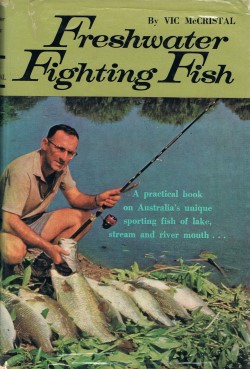
McCristal conversed with fisheries scientists and every informed source he could meet in order to understand Australian angling species.  He had a special respect for tarpon and giant herring, fish that today I still believe are largely under-rater by Northern anglers, who bypass these species for, well, tastier fish; or else do not target these wonderful acrobats with the light tackle that truly does them justice.  McCristal's guidebook works such as Freshwater Fighting Fish and Great Fishing With Lures are in many respects as innovative and informative today as when they were written in the late 1960s.  Certain information is, as one might expect given guidebooks over 40 years old, now outdated.  But there are special insights that come from McCristal's own application of angling intelligence to an experience that was often the vanguard of its field: seeing sport fishing possibilities and applying techniques to what were still new species of sport fish for the first time.  Such unique insights, in nuptial with lived experience, contain a special magic that shall always resonate for readers.  Which brings me to the second aspect of Vic McCristal's greatness, which is that he is a great Australian writer.


McCristal's prose style contains that blend of British-English command and accuracy with the idiosyncratic, landscape-attuned tone, colour and movement of Australian-English. It is a language that is both educated and lodged in the uniqueness of McCristal's Australian experience of the country and its characters.  It is a language one also finds in writers such as the early Thomas Keneally or Frank Hardy.  This language mirrors the diversity of escarpment country, with its rough hewn peaks and drops, crag-grappling foliage and poetic flourishes of monsoonal forest and lucid, pandanus lined, fish-shimmering streams wending between.  To cut to the chase, McCristal is not only a pleasure to read: his prose is a part of the history of our country's language and literature.  It is, as literature, a kind of equivalent of the uniquely Australian rock sound produced during the early 1980s or the Australian Modernist art of the 1940s, a time before the homogeneity of mass, popular culture eroded idiosyncrasy on behalf of economic and marketing interests...  a time before every populist cultural product was market tested prior to release.  But unlike the puerile 'national culture' cultivated during the Howard years, McCristal's Australia really is uniquely Australian.  For what makes this country unique is its landscape, its rivers and sea and the strange creatures that inhabit it.  McCristal's love of the country, its landscapes and its fauna, lead him towards ecological positions that the political Greens would agree with.  In The Rivers and the Sea he writes "I've been told that many conservationists are only trouble makers.  It would be funny if it weren't so tragic - those I know are the least warlike of human beings.  What kind of man would it be who could blandly suffer the earth's injury and not speak up?" The German philosopher Immanuel Kant defined the Enlightenment with the phrase sapere aude: have the courage to use one's own reason; dare to know.  This is what McCristal does, basing his opinions on his own lived experience rather than jumping on another's boat.  It is a lesson we all can benefit from.


Through his direct contact with the people who inhabited the wild places he cast his lures into, McCristal came to believe that colonisation had wrongfully affected the indigenous people of this country, and that, in general, those who had their culture still largely in tact were more human than the European Australians: "I can't convince myself that the efforts to convert the Aborigines to our own stilted format is better for them than their original tribal life.  The process of accelerated change is being forced on people with a different and (to me at least) more pertinent philosophy.  Their lives have always been links in a long, perpetual chain, while ours have been self-centred and erratic, often arrogant and devoid of comprehension of the truth of ourselves, at least as we relate to the ground beneath our feet."  Saying such things in the late 1960s - and in books written for a white Australian, populist audience - took both courage and a strong fidelity to experience.
Behind Vic McCristal's great Australian prose lies a self-hewn philosophy of nature: the best a human can achieve in life is to be intimately attuned to the natural world: "I seek to show that with clean rivers and a healthy ocean, man's spirit still has its wide horizon."  That this position arose through hunting and fishing is not a chance event, but is rather what happens to anyone sufficiently devoted to such activities, which lodge the hunter or angler in the natural environment in a uniquely attentive and attuitive manner.


"When a man understands the two kinds of hunting, it becomes difficult to maintain enthusiasm for the artificial kind." By 'artificial kind', McCristal means hunting or fishing simply to kill rather than taking a creature's life for food.  The kind of hunting shown in the infamous kangaroo scene of what is perhaps Australia's best film, Wake In Fright.  When people, generally shocked, ask me why I release fish, I tell them it is because I have spent so much time stalking them and observing their behaviour that I appreciate fish too completely as uniquely living beings to regularly kill them.  Fish have a right to live of their own accord, not just as an extension of the human appetite.  Of course I do sometimes take a fish to eat - of late, each time I hook a queenfish I have hoped it was a mackerel, which I very much enjoy eating.  This sentiment is something every keen sport fisherman understands, and we find its philosophy nowhere better espoused than in Vic McCristal's writing.  A hunter or angler should only kill what they intend to eat, and should always bear in mind conservation of the species one chases.  This gestalt switch in ecological attitude which takes place in those initially most committed to hunting and angling stands as a testament to the special orientation towards nature that is native to these activities.  Perhaps we become more fully immersed in the kind of hunting and gathering that the long development of the human body has evolved in relation to.  It is true that, in these activities, the senses intimately absorbed by the natural world, we become gladder, throwing free the stress of the modern and highly unnatural environments of work in which our badgered bodies etch out a living five days a week.


"(H)umility in our regard for the earth and the life systems on it is not misplaced."

In one of his books, McCristal tells readers the story of how he turned towards a life in pursuit of a happiness written in the natural world.  He had heard rumour of a run of large bream along a local beach and, on the way back to work after a break, decided that tackling the rare event of a run of big sea bream was more important than returning to work.  The beach and angling, thankfully for his readers, won out.  As recompense and explanation, when McCristal turned up to work the following morning he presented a pair of 2 kilo bream to his boss.  The boss promptly threw them back.  McCristal then understood that his boss, following the rules, was really just ruled by fear and resentment.  From that incident and momentary decision Australia's greatest fishing writer was born.


One of the most pertinent lessons we may learn from McCristal's adept writings on angling is that fisherman are not dunces.  Now let me explain what I mean.  Companies and media that are focused on making the most money from the greatest number of 'consumers' tend to make 'products' that have the widest reach, simplifying writing (copy) and marketing in such a manner that the target is assumed to be a mass idiot whom, massaged the right way, will cough up the appropriate profit or response.  This economic interest has a lot to answer for, not only in terms of 'dumbing people down' by always catering to and never challenging prejudices and wrong beliefs or opinions; but for making rare the kind of journalistic writing, literary in both style and content, that we find in Vic McCristal's works.  For McCristal educates as he guides readers, never assuming that his reader's are dullards.  His language is alive with unique human feeling and insight, and it is a great testament to the special kind of intelligence the long periods of angling in nature brew in a fisherman that so many anglers will cite McCristal as their favourite fishing writer.  It has been a revelation for me to scour Vic McCristal's books, and I thank the forum user who suggested I track them down.  It has already improved my fishing.

I have noticed across the years a trend to hang a crank tag on conservationists of every kind.  Some deserve it, some don't.  But you will observe that those who are exposed to an intimate knowledge of the sea, the rivers or the land itself, usually change their views rapidly.  Men who once killed are now the primary fighters in defence: Dr Hans Hass, Jacques Cousteau, Jacques Picard, Ben Cropp, Ron Taylor, John Harding; all with one thing in common.
The Sea made them famous.  They love it and they know it - and they're desperately concerned for it.  They merely know their subject, as I know mine, closely enough to know when it is being hurt.
- Vic McCristal, Preface to The Rivers and the Sea.


Sunday, 24 March 2013

Some Philosophical reflections on Fishing, Nature and Technology

What fish feel, 
birds feel, I don't know - 
the year ending

- Basho
An ice-cold slab of mountain rainbow trout from a New Zealand stream after two days of trekking
I still feel the first fish that struggled against my grip.  The river was the Barwon, the gape of its sandy mouth.  I stood beside my father, dangling stiff nylon lines and old fibreglass rods bridge-top into the torrent below.  This bridge was not a suspension, yet when cars rolled by it rattled and shook.  The rods belonged to my grandfather who, by that time, was ravaged by Alzheimers, folded into a wheelchair, blowing snot bubbles when he breathed.  He was an outdoors type who enjoyed camping.  When still in Finland, when the Soviets invaded, he was an army sniper, killing many men and collecting their red stars.  But he killed more redfin – European perch – in the lakes of Finland, and continued chasing these fish in the lakes of central Victoria.  A marine engineer, he would meticulously take apart his fishing reels after each trip, greasing all the parts to make them last.  We never went angling together, but to this day some of his old cane surf-rods are hanging from the roof of my father’s shed.
Kakadu saratoga

A fishing rod is much like a diviners stick, signalling to depths the eyes can’t see, a thread strung tight unto another world somewhat stranger than our ordinary.  Imagination treads this tightrope to the underworld: one reason why ‘the one that got away’ evermore resembles a plesiosaur as the factual memory of the event recedes.  Yet it is a rule that big fish escape and small fish do not out-wrestle a line.  On this day of my first caught fish I felt across my fingertips the darting electricity of a creature that, after several violent taps of the rod tip as it bit upon the bait, was hooked.  A fishing hook is a cruel instrument whose entire purpose is to rip into organic flesh and, once hooked, hold.  Some people claim that a fish does not experience much sensation.  Yet anyone who has struggled against a fish knows that fish do their best to resist the line and hook that binds them to a rod and human hand.  Despite the beauty of the locations angling often calls a fisherman to, what makes angling exciting is the act of and specific comportment towards fooling a fish, of fighting it into shore, of drawing away from its liquid world a being that does not belong where the angler stands.  The pleasure of catching a fish is largely located in this primal cruelty, a bodily struggle between two beings, however uneven this often seems.  Anglers call this struggle the fight.  For the first time I felt this resistance on that bridge across the Barwon, a strange ichthyological being direly struggling against me, fighting for its life against an incomprehensible force.  Hell for fish lies not in the dark depths, but is upwards, in boats, on shore.  A fish torn from water suffocates slower than a human drowns, and for me there are few crueller scenes than a waterless white bucket filled with the sporadic spasms and pouts of suffocating fish, a scene that unfortunately occurs innumerably on piers and estuaries each weekend.
A big brown trout from a New Zealand River

I no longer kill any fish, releasing all I land unless a fellow angler, looking desperate, asks for a fish I catch, or I cannot revive one I have caught.  My respect for wild predatory fish and the long hours I have spent stalking them, watching them, somewhat lessens the pleasure their flesh now provides my tongue.  But that first fish I caught, a young Australian Salmon, had its throat promptly slit, was gutted and bled, and an hour later its flesh was firming beneath a holiday-house grill.  In Istanbul, atop the Galata Bridge, rod fishermen catch similarly small mackerel that are swiftly gutted, splayed, grilled on the spot and sold on crunchy white rolls, bones still threading through the flesh.  My grandfather cherished the taste of redfin, a fish native to Europe, a pest now in Australia, brought here by the colonisers, like so many feral species, to make them feel less homesick for the Midlands of England.  Similarly, the appellation salmon, thrust upon the Australian namesake fish, is another colonial import.  The Australian salmon is not a salmonoid, but a completely unrelated species, a fast and powerful predator that frequents rock-hewn white-water and long surf beaches.  Pound for pound it is one of Southern Australia’s best fighting fish.  Some years ago I was on a pier when a school of kilo-plus fish surrounded the pylons.  Anglers slaughtered them, hauling in great numbers, tiling the wooden planks with fish.  When the school dispersed one of the fishermen asked me, with 30 noble salmon shimmering and suffocating around his wet feet, what type of fish it was and whether it was edible.  They are a mainstay of the pet food industry I told him, generally not noted for the delectable quality of their flesh.  Two nights past, on another pier, a group of budding men, drunk and loud, caught a young shark, 40 centimetres long.  They were hyenas, cackling, dangerous, swinging the shark around by its tail.  From a corner of the pier a thick accent emerged, If you not eat the shark you put it back to sea.  The hyenas hesitated, then the speaker stepped forth, an elderly Maltese man who looked like he had spent his life on piers atop the sea: If you not eat the fish, you release him.  Maybe it was the moon behind him, or the way his voice, supported by the ocean wind, grew larger as it approached, but the man holding the shark quickly flung it back into the water where, despite the violent whack of the surface, it dove into the deep, its life regained. 
A Darwin golden trevally

The cruelty of hooking and fighting a wild fish is of a different order to the cruelty that, reifying life into an object of utility, allows a fish to slowly suffocate in a plastic bucket, or the remorseless industrial fishing practices that are indiscriminately pillaging the sea so that seafood eaters needn’t slice the living throats of the fish they eat and cat owners can buy cheap tins of meat.  At the conclusion of Earnest Hemingway’s The Old Man and the Sea, a bourgeois couple comment tritely upon the shark-ravaged carcass of a proud billfish, as though it were these alienated gazes themselves that had carved up the noble billfish, the latter a symbol of a less alienated relation to the natural world.  They cannot see the epic struggle between the living fish and the old fisherman, nor the pathos and respect the fisherman bears towards the deceased billfish.  They see an object, a ‘fish’, that is useless to them because sharks have eaten its flesh.  At best it is a spectacle, a photo.  The tragedy is lost on them.  The anthropologist Marcel Mauss, in his essay The Gift, describes how, in ‘archaic’ societies, one could not simply take from nature in the way that the term ‘natural resource’, in its ordinary usage, suggests.  The latter term orientates us towards ‘the natural’ as a resource wholly at the beck and call of utility.  The German existentialist philosopher Martin Heidegger describes this orientation as enframing: enframing sets-up the natural world – it presents it by perspectivally privileging a particular mode of revealing the natural world to us - as a mere resource, a ‘standing-reserve’.  Heidegger argues that this mode of revealing the natural as a standing-reserve, at hand and ready for human domination and exploitation, is a revealing made possible by an outlook inherent in technology.  Yet technology itself is not a bad thing if one holds a creative or poetic relationship towards it and the way it unveils an aspect of the natural, keeping in mind the danger inherent in its outlook, the danger of reifying beings into mere number and use-value.  For example, power produced through fossil fuels discloses and bestows a very different relationship between humans and the Earth than the relation set up by solar power.  Similarly, the technology of an industrial fishing vessel unveils the being of a fish in a manner vastly different to that of the technologies of polarized lens sunglasses and the high-modulus carbon fibre fly rod and reel of a fly-fisherman stalking a wild trout in an alpine river.  Returning to Mauss, the ‘archaic’ societies he describes in The Gift did not see the natural as a free resource, at-hand for mass exploitation and domination, but as belonging to a cosmology wherein matters of economy, environment, culture and religion were inseparable.  What was taken from nature was in fact a gift that had to be returned - often via forms of sacrifice – in order for the relation between humans and nature to be kept in balance and thus able to sustainably reproduce itself from year to year.  One respected what was killed or taken from nature as a being belonging to this total world, as something still mysterious, participating in forces beyond human understanding.  Objects and beings are no less ontologically mysterious today. Yet rarely do we confront the mystery of how a thing is.  Our secular world smoothly effaces the irreconcilable difference inherent in things.  For this difference – in part pointed towards by the difference between the signifier and the signified, the impossibility of congruence between the sign and the thing – discloses both the arbitrariness of signification and the precariousness of all we think we know. 
A New Zealand lake

Sometimes when I am angling it occurs to me that I am standing in a mystery.  I muster such an intense concentration upon the act of casting and retrieving a lure, upon the technologies of rod, reel, braided line and the way these sensitive instruments disclose to me a certain terrain mostly hidden beneath a glowing, shifting surface, that I am able to retrieve my senses from the secular familiarity offered by signs and re-cognizable forms and see that which surrounds me as I have never seen it before.  For indeed I have never seen it before, the ceaseless becoming of the glimmering water, the reflections that grow and fade with the movement of the wind, clouds and sun, and the quivering of leaves on overhanging trees, their branches lazily swaying.  A quiet rapture sets in, focused on a rod, a lure and a potential fish.  Generally I wear polarized sunglasses, which disperse the most silver reflections, allowing me to see partly into the deep until the water swallows up and holds to itself all reflected light.  Sometimes I can see a fish following my lure, an alien being in a foreign world, darting to and thro curiously, mouthing the lure and then, my heart gasping, collapsing into itself, next unfolding breathlessly, the fish attacks and is hooked.  Though generally one cannot see the fish, and it is the violent tweaks of the rod tip, at other times a sly and gentle twitch, that tell me there is a fish down there preying upon my lure.  This concentration is not unlike meditation where one is wholly focussed upon ones breath.  But with angling one is focussed upon a technology and the world it reveals, in an environment that is often beautiful, and I’ve spent thousands of dollars purchasing the lightest line, rods and reels such that these technologies disappear into an accentuation of my own senses, my nerves tenderly leaving my flesh and streaking into the water, through the sky’s reflection, towards a fish.  When I have hooked a fish the fight takes place as though inside me, as though I were the lake or river and each flick of the fish’s dorsal or tail fin sends shockwaves through my delicate banks.  I sense the fear of the fish as it struggles, yet also its pride and predatory fierceness, its will to resist.  I use light line to give the fish a real chance of escape.  I do not ignore the cruelty, but experience it as tragedy, the affective excitement dividing the seconds into years as, one moment, the fish takes a powerful run and seems destined to escape; the next, I’ve gained some ground and am reaching for my net, then the fish again makes a run and in a dash of light, with a fling of water streams away from sight.  I shake with excitement, all the while respecting my opponent.  When the fish is landed its living beauty outshines that of any inanimate diamond, otherworldly, wild, surging with the very mystery of a being that is, of its own accord, alive.
Then I let the fish go.
A surface lure gobbling Siamese barb, Northern Thailand

For what we may call human pre-history, that long brewing and over-fermenting of the modern form whose records are kept in the bones and tools of those ancestors unearthed by paleoanthropologists, humans hunted all the animals they ate.  Although the thoughts and ideologies of humans are the fickle matter of changing histories, the flesh that houses these phenomena takes much longer to change.  In The Genealogy of Morality, Friedrich Nietzsche traces the origin of bad conscience to an anthropological leap in pre-history, from the long period of hunting/gathering to settled, agrarian social groups.  The human organism, its instincts shaped by the hunting/gathering style of life, was used to expending its energy in hunting and pursuing prey, taking long walks gathering, living from day to day.  Such hunter/gatherers, when moved to agrarian conditions, would be akin to placing a free and wild dingo into a suburban backyard.  The instincts useful to hunting and gathering of course, taking countless millennia to perfect, could not adjust quickly to agrarian lifestyles, even though consciousness could.  Hence Nietzsche contends that these unexpended instincts turned inwards, hunting the very human organism itself, creating a conscience to hunt consciousness.  Indeed, one need merely consider the degree of cruelty upon oneself and others that the moral religious conscience takes pleasure in.  There are forms of cruelty that affirm life and forms that degrade life: cruelty has a way of orientating us towards other beings, opening their being to us in a unique manner.  For cruelty is a force subjugating another force, taking pleasure in this subjugation, and the more equal these forces are the more fully one force must disclose and give recognition to that which struggles against it.  Hence the Hegelian master cannot recognise himself in the slave whom he subjugates, the slave giving no resistance.  To give ‘recognition to’ is to acknowledge the independence of another.  Hence those forces which most resist each other are most independent in their beings, yet this independence can only be recognised by the intimate contiguity of struggle with the most equal.  Cruelty gives the least recognition of the independence of a thing’s being when the relation between a subjugating and subjugated force are most utterly unequal.  For an industrial fishing vessel, each fish is merely a market value, a commodity, the independent being of a fish hardly recognised as anything other than an economic resource.  The stakes between boat, long line and fish are hideously unequal, and the ‘consumer’, eating dinner after another long day sitting in the office, is completely alienated from the living being of the fish and its death.  On the other hand the catch and release angler, using finesse fishing tackle, has an intimate relation with his or her quarry, just as humans have for most of history when hunting.  The technology the angler uses only makes the fight between the angler and fish more dramatic, equal and intimately experienced.  Using lures means the fish is caught whilst itself intent on consuming a smaller prey.  It comes as no surprise that much Japanese fishing tackle, the best designed in the world, carries connotations of the Samurai tradition.  Indeed, one series of reels, designed by Yuki Ito, the founder of the aesthetically orientated tackle brand Megabass, has etched into their spools the characters Ki Shu Bu Shin, which translate as Hand of the Devil, Buddha heart: although this fishing tackle gives you the power of a devil’s hand, do not forget your compassion. 
Megabass Kirisame... JDM angling aesthetic ecstasy!

The catch and release angler, without a bad conscience, releases his or her fish as a sign of respect, an acknowledgment of the fish’s life, its fight and its capacity to grow and breed.  If a sacrifice takes place, it is the amount of money and time expended upon an activity that, if one refuses to kill and keep fish, provides no economic return, no causa finalis subordinated to utility.  In this way the sports angler is not dissimilar to an artist, creating aesthetic situations in beautiful locations where one can experience anew ones relation to the world, nature and to the being of things that inhabit such environments.  But where they differ is that, whilst the experience of the creative artist generally leads to the memento-mori of a finished art object, the experience of the angler and his prized quarry is, apart from a photo, mutable: it returns back into the mystery of the Being that gave it birth just as the glimmer of a released fish returns to a river’s depth, as lost to time and the clarity of memory as a wisp of cloud reflected atop a babbling stream.  
Just another New Zealand river...
A lovely little brown trout from an Otways stream, Victoria

Friday, 22 March 2013

Another Drive Through Kakadu

I must admit I am a little dumbfounded as to where all the barra must presently be.  This time last year I was averaging between 20 and 30 barramundi a day in the streams of Kakadu.  But last year it rained.  Last year there was a wet season and a run-off.  This year... disappointment.  And already the spear grass is seeding into its tri-coloured displays.  The dragonflies that mark the dry's beginning are emerging.  Perhaps - hopefully, indeed - all this is wrong, and something resembling a wet, even just a few days in a row of heavy rain, will arrive.  But as it stands... one must content oneself with the plentiful tarpon.  As to the latter, if I was living anywhere else, especially in the Southern states, and I could go fishing and catch 20 leaping, tough scrapping game fish in beautiful streams on trout gear, I would call it a mighty good session.  Maybe we come to expect too much in the NT.  Or, more likely, big barra are a fantastic fish to catch... when they are about!
Topwater tarpon on their beloved Smith Towadi.
My first stop on my drive to the '3 Bridges' and back was Scott's Creek.  There had been a few spots of rain in the preceeding days, and after losing 4 barra there a week ago - 3 quickly to thickly matted reed beds; and a good fish that sliced my leader with its sharp gill plate - I had high hopes.  But the water wasn't quite so high.  In fact, it had dropped by at least 20cm.  Where I hoped to cast for barra with some heavier tackle, there now lurked only fully exposed, thick beds of reeds.  But below the crossing were tarpon.
The crossing at Scott's creek, with not as much water as should be there...
So I started out with my 2 - 4lb Daiko Elzarle matched to a 1000 FB Stella and 4lb Untika trout braid.  Quickly i found this small trout stream 'noodle' was outmatched by the power of the larger tarpon I hooked in the fast water.  I could land the fish with a fight that did them all the justice they deserve... but what if I hooked a barra?

A larger tarpon on a topwater.
So I upgraded to an Evergreen Kaleido Designo with 5lb Varivas Ganoa Absolute Fluorocarbon straight through.  This is the best fluorocarbon line I have used - no wind knots and great abrasion resistance in a light line.  It will be interesting to see how it holds up to a barra mouth.
The tarpon were not striking at the Smith Towadi walk the dog lure as readily as during the previous week, so I tried to match the hatch - some kind of tiny fry - with this offering...
Which the tarpon readily struck at, yet hooking them on the small jighead was a problem. Hence it was to a twister grub I turned next, on a larger hook.  Which gave a better hook up rate.  I would cast slightly upstream, hold the rod tip high and let the lure sink and drift down until it hit a small eddy where it would wiggle its tail in the current before being hit upon.  Kind of like a lady in a Darwin bar.

A Gary Yamamoto grub...
Megabass grub...
 Then back to the Smith Towadi once more: surface fishing for tarpon is just more exciting, even if the hook up ratio is less.  And I have found that larger specimens take surface lures.

The little Smith Towadi claims another victim.
After an hour of catching tarpon every several casts, it was towards the streams of Kakadu I drove.  First stop was the East branch of the Wildman, which was flowing fast and clear.  Second cast and I was attached to a solid saratoga... which I played to the bank, and then lost as I left in in the margins as I unfurled the brag-mat and got my camera ready.  There goes saratoga number one.
A short walk upstream and another 60cm saratoga was spotted.  I cast the little Duo popper perfectly, and again was attached... then again stupidly lost the fish before I could get a photo.  This was, unfortunately, becoming a bad habit. A change to a heavier outfit and a weedless stickbait, and I was once more hooked to something powerful in the current. A valiant... catfish.  Boy these fish can pull, even if they cannot pull much affection from an angler hungry for barramundi and saratoga.

Oooo... that feels like a good fish... o god... catfish!
 Some mosquitoes soon after drove me off to the next stream, where I found more tarpon and a beautiful spangled grunter that sure knew how to grunt.  I'm surprised the fellow didn't attract some pigs with all the noise he made.
Spangler Grunter on a DUO popper. 
A pretty fish, and great fun on the right tackle in meter across top-end streams.
That wouldn't be another... Tarpon?
Next stop was Magela Creek...

I landed a single, very golden barra of around 50cm on a Megabass X-Layer... but the camera was in the car.  With camera back in hip pocket, I just could not hook-up.  Interestingly, after also fishing Magela on the way home the following day, I discovered two important points.  Firstly, the fish were being spooked by some of the larger lures other anglers were hurling about.  They - by which I mean a school of tarpon and a few small barra - had moved upstream from where the most casts were meeting the water, sheltering between a few weed beds.  They had become very flighty at the nearest splash.  I noticed a similar phenomenon last year, when barra in Nourlangie Creek II were literally bolting away from white (drop-bear) Squidgy fish.  Secondly, almost all the hits I had were on finesse tackle with a lighter leader (8lb Varivas Trout Fluorocarbon).  I was fishing two outfits interchangeably - the heavier had 25lb Sunline Rockfish fluorocarbon leader - and the difference was very noticeable.  Fish preferred the superior presentation offered by a lighter outfit.  Now if these were bream in the Yarra River, such an approach goes without saying.  But even in the NT certain places can see a lot of angling pressure and fish quickly wise up. As more people move to Darwin and popular angling locations meet with increased pressure, the older barra gear and big bibbed lures may not quite make the mark they once had on wild fish populations that rarely saw lures.  This is certainly unfortunate, but it also necessitates a turn to a creative diversity of tactics if one wants to keep catching fish as in years past.
What happens when there is a run-off...
An insulting Southerner's finesse barra outfit!
By now the sun was setting, and a day of fishing in and around Kakadu had only produced a single hooked and landed barra during a time when the barra blockbuster run-off should be reaching its apex.  
I wonder what this Magela Creek resident thinks of the lack of rain?

After setting up camp, I headed for a nightfish at the 3 Bridges: Nourlangie creek.  I had a few hits on a Megabass Speed Slider using a fast walk the dog action, but no hook-ups except a several second tug-o-war with what I thought was a small freshwater crocodile that had on several casts chased my lure.
When I checked the area the next morning, I discovered that the small freshie had claws the size of my hands, and had left large belly marks and what looked light egg-diggings in the sand... I was quickly out of there, not wanting angry-protective-mother saltie snapping at my tackle... It was back to Magela Creek, where I hooked one more small barra, watched other anglers scare the crap out of the tarpon, and continued to wonder at the absence of a wet season and the lack of a run-off. 

Two days and a night fishing in Kakadu, and all I can state is where the hell are all the NT's barramundi? Perhaps I should start heading West instead of East and explore the Daly River region's land-based offerings.
30 cm of water over the Magela Creek crossing, and falling.  Wet Season anyone?

Thursday, 14 March 2013

Darwin and the Milkfish


I had two milkfish sessions after work last week.  Not wanting to peeve anyone off by giving away co-ordinates of a certain not so secret 'secret spot', milkfish are verging on being a plentiful sport-angling target in Darwin Harbour, and could perhaps pull all except larger pelagics like tuna backwards in a power tug-o-war.  Pound for pound they put any barra to shame.
A Milkie puts a bend in a 6 - 12 lb Loomis NRX 

I have had big milkfish strip towards 100 yards of line off a spool in around 10 seconds, then begin leaping several feet out of the water.  Like bonefish, milkfish use speed as their main weapon of defence against larger predators.  Unlike bonefish, who are at times opportunistic feeders on shallow flats and will hence take a baitfish imitation, milkfish are almost completely vegetarian, preferring algae to tasty flesh.  I had one chase a very small paddletailed plastic last year, but using a 1000 sized reel with only 90 meters of line on the shallow spool, i decided to keep the $60 worth of braid on the reel, so jerked the lure away as quickly as I could.
Trying to get a fish back into the water ASAP... Action!

Last week I hooked four milkfish - three on the first afternoon, one on the second evening.  I am having a quite successful streak with losing big fish of late in circumstances where it is not quite my fault... or so I must tell myself!  The first three fish were all lost to leader abrasion thanks to oyster encrusted rocks.  I was using a suppler 25lb fluoro leader (Varivas Seabass) than my usual choice, hoping this suppleness would lead to better presentation of my milkfish bait of choice: one dollar loaves of white sandwich bread from Coles.  The presentation was better, hence the three hook-ups, but at this particular spot the milkfish tend to run between 50 - 100 yards and then arc into the shore, after which one must fight them back across rocks.  If you put the rod low at an angle, pressuring them towards the shoreline they are speeding towards, they will often swim in the opposite direction into deeper, clear water... but the ploy failed me on this occasion, and each time a fish arced towards the shore, my line fell limp.  Nonetheless, I landed 2 extra large diamond scaled mullet, my lovely mistress landed another hefty slab of mullet, and a friend landed a very amply sized giant herring that danced across the surface all the way to shore.
Big Diamond Scaled Mullet are hefty fish, and can even get airborne on the end of a line!
Fancy dancer: a Giant Herring on a Bomber and a happy angler's grin.

The following day I switched to 30lb leader, and although fewer fish showed up, I hooked a fish that appeared well over a meter.  After it took two long runs, I thought I had the fish fought, slowly zagging left to right only 10 meters from shore.  I had loosened the drag of my 2500 Stella, loaded with 16lb Varivas Seabass PE, and was holding my rod tip high, just in case the fish decided on one last sprint from so close to shore.  Then the line fell limp.
My first (landed) Darwin Milkfish - from Cullen Bay Rockwall

Oddly, losing the biggest milkfish I have so far hooked, I wasn't as devastated as I may have expected: I had fought the fish well on 16lb braid and a 5-12lb rod, and I really seemed to have the silver vegan monster beaten.  The hook had come lose, which is not out of the ordinary with milkfish: they have tiny mouths for their size, so I use at largest a size 4 hook, but generally a size 6 to 8 hook.  Still, a photo would have been nice.
The writing desk before a milkfish session. Four loaves are standard.

For those eager to battle one of these magnificent vegetarian athletes, there are a few basic pointers I can give to help make it happen.  Firstly, bring at least 4 loaves of bread, and burley constantly.  I have tried a double method of using moist breadcrumbs, which you squeeze into a ball and let sink, as well as torn up slices of white sandwich loaf on the surface.  This certainly attracts more fish, as well as other species like pikey bream and golden trevally, but it means that the fish feeding is not concentrated on the surface.  So now I just tear inch square sections of sandwich bread.  The burleying must be constant to attract and hold a school of fish, who will follow the trail back to the source, where you'll have your bait!
Wheat.

Secondly, as I stated earlier, milkfish have small mouths.  A trick I like is to make your bread piece smaller than the sections you are tearing off.  A milkfish will choose a more mouth-sized section of bread over a larger piece.  My technique, again, is to get a one inch square section of bread - not crust, which will break off the hook - and to gently fold it with enough pressure at the folded end to hold the two folds together,  You want the bread to float and remain fluffy.  Pass the hook through this folded corner, and it should stay on.  Quickly and gently dip it in water to partially wet it for some casting weight.  As soon as the bread starts sinking, replace it.  Don't forget to bring some quality polaroids, as milkfishing means sightfishing, watching your bread bait like and osprey.
Decoy single lure hook.

Lastly, hook size and leader material is very important.  Milkfish have excellent vision, and regularly will suspiciously  pass up an 'unnatural' looking piece of bread, a very visible leader and a larger hook.  My hooks of choice are Decoy single lure hooks in the equivalent of size 6, which are very sharp and strong hooks. I am yet to have one bend on a fish.  Leader material should be fluorocarbon or, if you can get away with it in the absence of oysters and sharp rocks, a high-flotation quality nylon.  If fishing from a boat in clear water, you could use as light a leader as you liked for the toothless mouths of milkfish (from a boat I'd be using 6 to 8lb fluoro straight through on a 2500 sized real and a 7 ft, 4 - 8 lb rod, making sure I had at least 200 yards of line on the spool).  But, unfortunately, from the shore there are too many abrasion hazards when battling such powerful fish, so heavier leaders are necessary.
This meter fish was taken on a Zenaq Seabass rod with a Daiwa 3012 Hyper Exist and 30lb braid after losing a fish on lighter tackle.  Outgunned!

A good place to begin any milkfish hunt is from the end of the Cullen Bay rockwall an hour either side of high tide.  I have also seen them off east point, and along a few Darwin beaches and sandflats.
Put some shoulder into it...

Here are a few shots of other species you can expect to catch when fishing bread on the surface while chasing milkies!
Pikey Bream, like all bream, are bread junkies.

Mullet...

.telluM

This batfish gave an awesome scrap on 12lb PE, a 2000s Stella and a Breambuster Ultra-Finesse.

Mulletbuster...

Cullen Bay rockwall Mullet.

Even Golden Trevally enjoy a bit of white sandwich loaf.  On this occasion I caught three decent trevors on bread off the surface.